


“I usually collect from the weavers here, then a collector comes to pick them up. One stagen goes for around 20 to 25 thousand rupiah.”
— Marsiyem, stagen collector, Dusun Sejati Deso
Dawn was breaking over Dusun Sejati Deso, Yogyakarta — cool, quiet, the kind of morning that feels like it belongs to the village rather than the visitors passing through. Six of us had made the 45-minute trip from central Jogja to visit one of the city’s surviving traditional weaving communities.

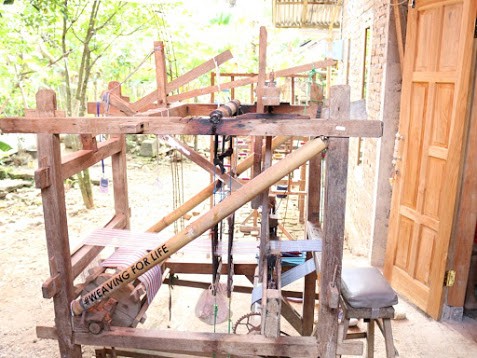
Dusun Sejati Deso sits within Desa Sumber Arum, Moyudan, Sleman — covering around 765 hectares. Its claim to distinctiveness: stagen, the traditional Javanese woven sash. Stagen is a long, narrow woven cloth — typically 10–20 cm wide and up to 20 metres in length — worn wrapped around the waist as part of Javanese formal dress, for both men and women, at weddings, aqiqah ceremonies, and circumcisions.
Most women in the village have a traditional loom at home. Weaving is a secondary livelihood alongside farming and sand mining — but it’s also an inheritance. The tools and techniques here are old, passed down through generations without much modification.
Innovation — Carefully
Traditional stagen is solid black. But weavers in Sejati Deso have been quietly experimenting: red, blue, green, and yellow stripes have started appearing alongside the standard plain weave. Some of these coloured cloths have been developed further into small products — woven bracelets, shirt pockets, decorative sashes for semi-formal wear.
“The small bracelets are 5,000 rupiah. The bags are 30,000. If you want a custom design, that’s possible too.”
— Mbak Sum, stagen weaver
According to Mbak Sum, these innovations came through an empowerment programme run by an outside community organisation several years ago. The aim was to increase both the quality and market value of what the weavers produced. The impact, however, has been limited: many weavers remain reluctant to produce coloured stagen at scale. The hesitation is understandable.

The Collector Problem
Weavers in Sejati Deso remain dependent on middlemen — collectors who gather finished cloth and sell it on at markets or to clothing traders in Yogyakarta. Bu Marsiyem is one of the local aggregators: she collects from the village weavers, bundles stagen in sets of five, and waits for the larger collectors to come and take them.
“Why no coloured ones?” I asked her.
“We don’t dare with the coloured ones. The collectors won’t take them — they’re afraid they won’t sell,” she said, without hesitation.
This is the bind: coloured stagen does sell, but more slowly and in smaller volumes than plain black, which has a guaranteed market. Without a collector willing to take the risk, weavers won’t commit to production. Without production volume, there’s no market development. The cycle holds.
The Tourism Village Ambition
Alongside the weaving tension, the village is pursuing something larger: becoming a recognised desa wisata (tourism village). The influence of neighbouring DIY villages that have successfully made this transition is clear. Sejati Deso has established a Pokdarwis (tourism awareness group) and is working to develop what it already has.

The assets: the Progo River running along the village edge, open rice fields, traditional weaving, and local food. Visitors can already use the river and fields for practical activities. The challenge — as residents acknowledged — is that building a sustainable tourism village is considerably harder than weaving a piece of cloth, even one that’s been made here for generations.
The hope is real. The road there is longer than it looks.
About The Author

Johan Ferdian JR
Goweser kalcer yang mencoba ngultra • #JurnalPedal #whatthefood #pijak #publica #intuisi #listopia


