


Sulawesi holds a great deal. Hilly relief, green still dominant, surrounded by blue sea with white sandbanks etched in abstract. In late July the previous year, I found myself exploring a beautiful corner of Central Sulawesi’s ‘k’ — the arm of the island that bends back on itself. Several media outlets were calling this place the “Raja Ampat of Sulawesi.” I’ve never been to Raja Ampat, and I’m not sure the person who wrote that headline has either. Let Raja Ampat stay as it is, in West Papua. The local people I met had a simpler, better name for this place: Sombori.
Almost a month living alongside the Bajo people on Pulau Tiga, Morowali, had made the sea feel inescapable. The Bajo are one of the largest sea-nomadic peoples — no day passed without someone heading out to fish. They have their own language and their own informal governance. It was the Bajo who brought me to this archipelago, which the local government had been promoting as Central Sulawesi’s flagship ecotourism destination.
Pak Suhardin piloted the body — a medium-sized wooden boat he’d named Monalisa, after his eldest daughter. On his left forearm, a tattoo in Chinese ink: the word Hasrat (desire). Made after a failed romance in Pontianak, he said, without elaborating. “We never know where our destined one is, do we?” he grinned.


Ninety minutes across open water. The waves subsided as we entered the calmer passage between the coral island cluster. Towering karst cliffs, dense with vegetation. A hidden beach glimpsed through branches behind a small island — white sand, pale blue water, shielded from the kind of traveller who photographs everything and feels nothing. The Monalisa continued to a lone stilt house standing between uninhabited islets.
“Assalamu Alaikum Nenek Endong!” Pak Suhardin called as he tied up. On the veranda sat an elderly woman with a young man and woman beside her.
They spoke in Bajo. I smiled and nodded, understanding nothing. Then the young woman turned to me: “Nenek says you look like a grandchild of hers. One who passed away long ago.”
I looked at Nenek Endong. A longing in her eyes — the same quiet expression I remembered in my own late grandmother. I kept smiling. What else could I do?
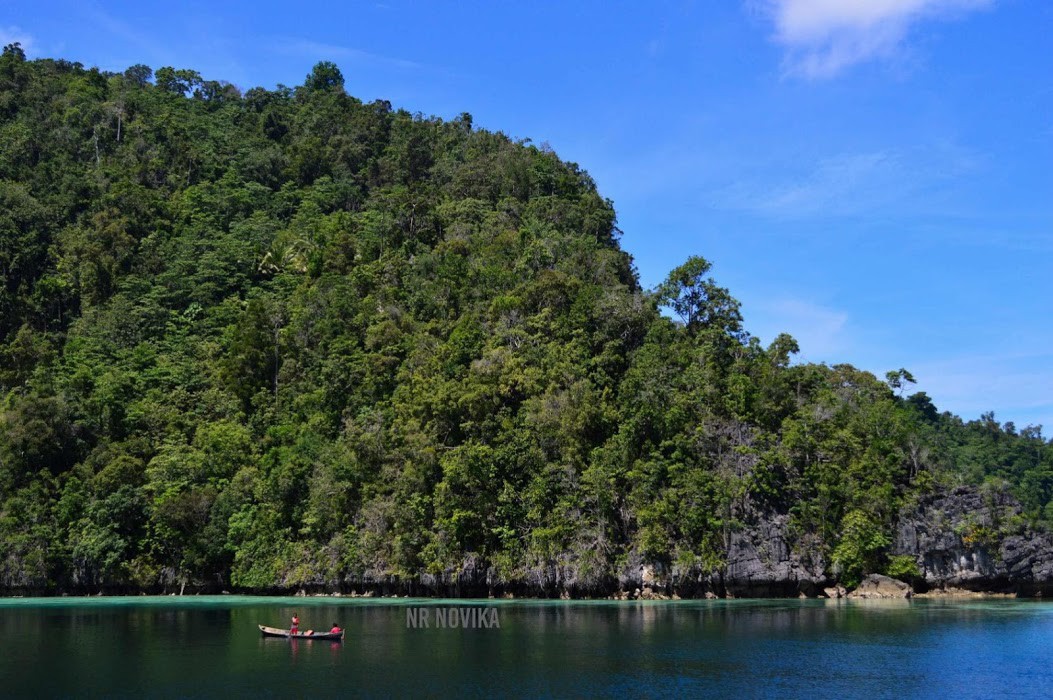
From the veranda, the view across the water was extraordinary. Gradient blues — pale to deep — crystal-clear in the midday sun, bordered by limestone cliffs dense with green. The Monalisa rocking gently on its rope. Nenek Endong, how fortunate you are to live here.
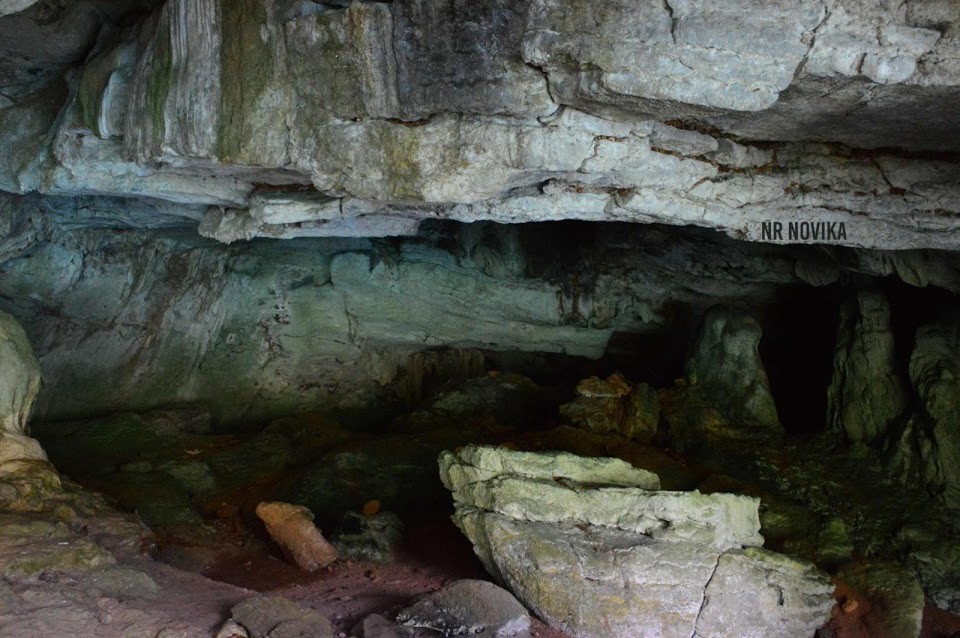
Behind the house: a cave with a quietly mystical reputation, said to contain human remains of someone who had once retreated there. Mas Fariz — a Javanese man who’d come to Pulau Tiga years earlier and married a Bajo woman, his Bajo now fluent where mine was nonexistent — translated as the conversation continued around me.
And then he relayed the real topic: the local government’s plan to develop Sombori as an ecotourism destination. The debate, apparently, was ongoing.
I borrowed a sampan with the others to paddle around the islets. Between two coral cliffs that formed a natural gateway — the kind that would appear in a Peter Jackson film — I put on a mask and dropped into the water without changing clothes first.
What I found was not what I expected. Almost no fish. Barely any coral. Mostly bleached coral rubble and white sand, scattered like the aftermath of something that had been broken apart. Blast fishing, or fish bombing with cyanide — both still common in Sulawesi’s waters — leaves exactly this kind of wreckage behind.
The local government may want to think more carefully about its ecotourism ambitions here. The familiar pattern in Indonesian tourism: announce the destination, attract visitors, skip the resource management and community preparation. The reef was already damaged. Promoting it without first restoring it only accelerates the loss.
Nenek Endong has lived alongside this water since she was a child. Would she consent to someone else deciding what it becomes?
Author: Nur Rakhma Novika (NR Novika). Fun diver. Ocean enthusiast.
About The Author

Johan Ferdian JR
Goweser kalcer yang mencoba ngultra • #JurnalPedal #whatthefood #pijak #publica #intuisi #listopia


